Strategy
The University of St Andrews Biodiversity Strategy 2025-2030
Our primary biodiversity strategy is to increase biodiversity and facilitate engagement with this biodiversity on the University of St Andrews estate. To use this process to empower students and staff members to make biodiversity positive decisions for the rest of their lives. We hope to help halt global biodiversity loss, by looking after the biodiversity on our land and through the indirect transformative effect of the biodiversity around us at the University. Practically our biodiversity strategy involves monitoring biodiversity and creating and improving habitat to increase species richness and abundance on the land which the University has responsibility, and engaging all staff and students with this process.
Biodiversity anywhere is valuable to us to maintain the ecosystems that allow us to exist, and to exist happily, on the planet. Creating and maintaining a biodiverse University of St Andrews will provide a pleasant and interesting environment in which to live and work, and allow us to fulfill both our moral and legal responsibilities to sustainability. We are in both a climate and nature emergency and a biodiversity strategy is necessary for the campus to become nature positive: the WWF states that all organisations should be nature positive by 2030. Furthermore, the UK has committed to protect 30% of land and sea for nature by 2030 (30by30), to support the global 30by30 target agreed at the UN Biodiversity Summit (COP15) in 2022. Action for biodiversity on the University’s estate is a core part of the University’s Sustainability Strategy, facilitating, enhancing and guiding the University’s aims to be carbon neutral, to use renewable energy and sustainable transport, to use local resources, to create a locally circular economy (e.g. composting green waste to support soil health) and to create a learning environment where thinking truly promotes rather than limits the opportunities for future generations. Conserving native biodiversity on the University estate will also contribute to climate resilience (e.g., carbon sequestration, flood mitigation, biosecurity).
Integrating climate adaptation into biodiversity strategies presents co-benefits, especially when guided by landscape-level planning. Diverse ecosystems naturally buffer against extreme weather events—such as intense rainfall, flooding, and overheating—by improving soils, regulating water flow, and providing buffers, shade and cooling through vegetation. A biodiversity vision for the University of St Andrews at landscape-scale can enable the creation of multifunctional green spaces that not only support ecological richness and climate resilience but also enhance student wellbeing and campus life. These biodiverse environments would offer restorative settings for learning, reflection, and recreation, contributing to mental health, social cohesion, and a stronger connection to nature. By aligning biodiversity goals with climate adaptation and student experience in development planning, the University can foster a more resilient, inclusive, and thriving campus landscape.
Biodiversity on the University of St Andrews estate consists of a small number of species of conservation priority and some locally important wildlife habitats. But all of the biodiversity we have is fundamentally important because it is the wildlife that we appreciate and enjoy every day that can transform us and so lead to biodiversity positive decisions. And in the University context, result in biodiversity positive decisions that radiate out from St Andrews as our students and staff go on to be the influencers and decision makers on a global scale.
Since the first Biodiversity Strategy was published in 2019, the University of St Andrews has continued to experience climate change and a global loss of biodiversity. Despite these challenges, the University has made progress towards creating more nature positive and eco-friendly spaces for students and staff. This progress has been achieved through close collaboration of everyone at the University, led by the Estates team and Transition. Together, we have promoted wildlife-friendly landscape management, increased the number of woodland tree species planted across campus, planted and connected existing hedgerows as part of the Green Corridors Project, and expanded engagement opportunities such as the annual Biodiversity Awareness Day.
The University of St Andrews Biodiversity Strategy is aimed to implement regional and national priorities; a local strategy nested within larger scale biodiversity strategies and the wider legislative framework. The University Biodiversity Strategy acts as part of the Fife Local Biodiversity Action Plan, which then acts within Scotland’s Biodiversity Strategy and within the UK national biodiversity strategy and action plan. The University Biodiversity Strategy fulfills our legal responsibilities to biodiversity. The University of St Andrews Biodiversity Strategy is our own context-specific strategy, but we also aim to incorporate other institutions best practice (e.g. other universities’ biodiversity strategies). Most importantly, the University of St Andrews Biodiversity Strategy is one of engagement of everyone to work towards increasing species richness and abundance, within the University, the local community of St Andrews and the East Neuk, within Fife and within Scotland. Although our actions may be local, we are thinking globally: the value of our actions for the species and habitats we look after is multiplied by joining them to others, and creating capacity for biodiversity positive actions globally.
The University of St Andrews Biodiversity Strategy and the actions that arise from this, the University of St Andrews Biodiversity Action Plan are organised by the Biodiversity Working Group. This is comprised of interested academic staff and students at all levels, as well as representatives of the professional and service staff tasked with carrying out the Action Plan. Every University staff member, however, has a role in implementation and should consider biodiversity in their day to day functions. The Biodiversity Working Group is chaired by Prof. Will Cresswell ([email protected]), who is the first point of contact for any enquiries about this strategy. The chair of the Biodiversity Working Group is part of the Sustainability Delivery Management Group.
There are two pillars to the University of St Andrews Biodiversity Strategy.
I Biodiversity Net Gain – to increase the species richness and abundance of native plants, fungi and animals on the University Estate.
II Engagement – to inspire everyone across the entire University community, from students to senior leadership to engage with the nature on the University estate so that biodiversity is properly considered in their every decision in the future.
Both of these pillars require strategic allocation of resources. The University of St Andrews therefore aims to increase the capacity to enhance the University’s ability to monitor, manage, and integrate biodiversity considerations into its daily operations and future development decisions.
Biodiversity Net Gain (or Biodiversity Positive) is carried out through initially mapping, monitoring and evaluating animal, fungi and plant species richness across the entire estate, updated annually. Opportunities for habitat or biodiversity improvement are then identified by the Biodiversity Working Group or any staff or student of the University and these are fed into the University of St Andrews Biodiversity Action Plan that is updated as and when, and annually during an afternoon in December each year, where all students and staff are invited to attend and contribute. Specific habitat management, species promotion, and engagement actions outlined in the Biodiversity Action Plan then lead into landscape management and conservation work carried out by dedicated University staff, alongside student and staff volunteers, as well as general actions that can be carried out by all students and staff. The process then allows biodiversity positive development and operational decisions by the University, so allowing the University to carry out and better the UK government, currently voluntary, requirements for Biodiversity Net Gain.
Engagement. We aim to engage all staff in promoting biodiversity through their functions with full knowledge and recognition of their responsibilities to make the University biodiversity positive. Engagement is promoted through training, teaching, opportunities to observe, monitor and conserve wildlife directly and through telling the local wildlife stories that bring joy, happiness and a sense of place to us. Particularly important is the creation of a natural history culture within the students and staff of the University: through appreciating the animals and plants that are here, we notice when they are not, and so make biodiversity positive decisions.
Pillar I: Biodiversity Net Gain
Biodiversity Positive – to increase the species richness and abundance of native plants and animals on the University Estate.
Targets
- To increase species richness and abundance of native species on the University Estate.
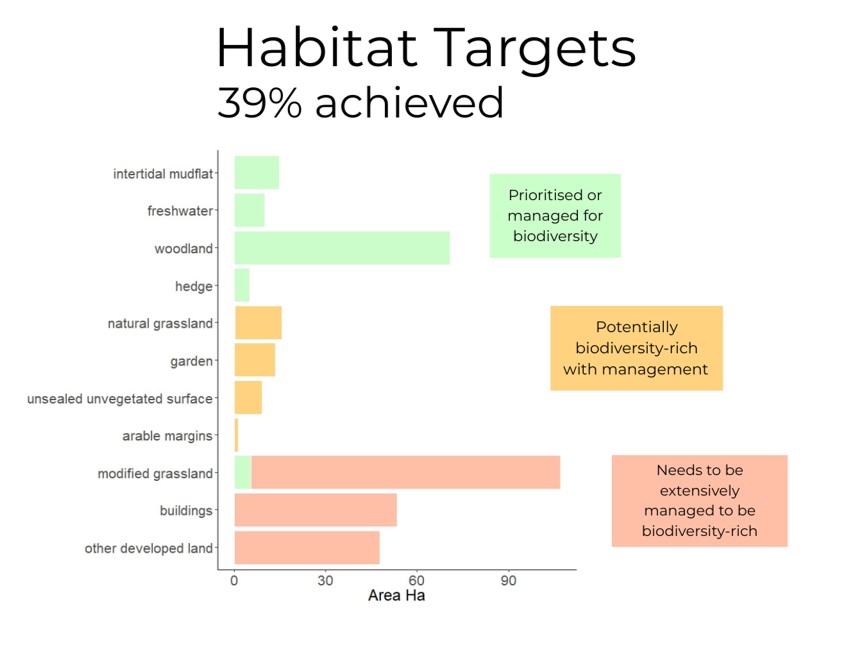
- To have 60% of University land under biodiversity positive management by 2035, with habitat quality improving year on year, as evidenced through increased species richness and abundance, until it is matched with the top 10% of exemplar habitats in Fife.
- To incorporate biodiversity positive thinking into all briefs for new developments, aiming for 20% biodiversity net gain, ideally on the scale of the development within the University, or overall across the University estate.
- To create a landscape level plan for Biodiversity Net Gain to to improve habitat connectivity between areas of the University and around it, working with other landowners and stakeholders in east Fife.
Figure 2: The state of habitats managed for biodiversity in 2024.
To achieve our targets we need:
- To monitor species and habitat quality.
- Actions to improve species richness and abundance, and to improve habitat quality.
- Capacity – i.e. strategic planning, coherence and coordination of actions that might improve (or reduce) biodiversity both within the University Estate or in the wider landscape.
Monitoring
Monitoring is carried out through Key Performance Indicators for biodiversity (Biodiversity KPIs). The monitoring methods are deliberately simple – essentially a fine scale bioblitz – where every single animal and plant species within a focal group is recorded and mapped on an annual basis. Mapping is carried out by students: 6 student summer internships funded annually by the University, students in the VIP module Biodiversity Literacy and volunteers from throughout the University. Species totals are then compiled to estimate relative biodiversity value of areas and habitats within the University estate. And most importantly, how this value changes in response to our management actions and development decisions, ensuring that these actions and decisions can be biodiversity positive.
The three Key Performance Indicators (KPIs) are:
- Annual (Abi): ‘Real’ KPI score for every year, scaled to 100 as the benchmark established in the first year. There are three separate measures: overall species richness, a habitat or area specific overall species richness and area managed for biodiversity.
- Use: achieving goals & identifying project allocation or success.
- Benchmark (Bbi): benchmark average species score to other sites in Fife and Scotland.
- Use: assessing institution relative performance & identifying successful management plans.
- Change (Cbi): annual change at sites and is found by subtracting the preceding year’s Abi value from that of the current year.
- Use: identifying site potential/response to management & core performance number to graph rate of change.
Figure 1: Species and habitats are mapped annually and an overall index created, scaled to 100 for the first year. This index can then be compared to local benchmarks of species richness, and annual change assessed.

Actions
Actions are carried out through the University of St Andrews Biodiversity Action Plan, a constantly updated document that lists specific actions to improve species richness and abundance, predominantly through habitat management and promotion of engagement with biodiversity. Specific Actions are to be found in the Biodiversity Action Plan, but these actions form two strategic themes – species and habitats.
Species Actions: The overall strategy is to increase the abundance of species of conservation concern, to increase the abundance of native species generally and to decrease the abundance or even the occurrence of non-native and invasive species on the University estate. Data on species distribution and abundance are summarised and visualised to allow small scale and strategic management actions via the Biodiversity Dashboard and QGis mapping databases maintained by the Biodiversity Literacy Module.
Species actions involve management of habitats for species of conservation concern, or particular engagement value. For example, red squirrels fit both categories. Species of conservation concern in habitats created and managed by the University of St Andrews include otters, red squirrels, corn buntings, lesser black-backed and herring gulls, Scottish bluebells, and local Fife aspen. These are identified and monitored through the actions described above, and from larger scale biodiversity action plans such as the Fife Local Biodiversity Action Plan.
The majority of species on the University estate are not of conservation concern, yet many have declined in abundance over the last century. Conservation is best achieved by preventing common species from becoming rare, by maintaining areas of suitable habitat and functional ecosystems. Most species actions are therefore enacted through habitat creation and management.
Species Actions also involve management of “biodiversity-negative” species. Some species such as Japanese knotweed and Himalayan balsam are non-native and invasive and reduce overall biodiversity. Some actions therefore involve the removal of these species.
Habitat Actions: The overall strategy is to increase the amount and quality of habitat managed for biodiversity. Habitat actions are crucial to conserving a wide range of specific species and overall biodiversity, and so are an efficient way to a biodiversity positive University. Data on habitat type, management actions and distribution are summarised and visualised to allow small scale and strategic management actions via the Biodiversity Dashboard and QGis mapping databases maintained by the Biodiversity Literacy Module. Habitat actions involve (1) habitat improvement and maintenance and (2) net habitat creation in new developments. Both should have special focus on habitat connectivity.
An example of improving existing habitats is the transformation of low-biodiversity amenity grasslands around the North Haugh to species rich wildflower meadows with Meadows in the Making – Transition St Andrews (for more details, see “achieved and ongoing” actions of the Biodiversity Action Plan). The aim is that students and staff perceive the University grounds as biodiverse-positive. This transition requires both a cultural shift—addressed through the engagement pillar—and continued investment in resources supporting the Estates team, as outlined in the capacity pillar. To sustain habitats such as wildflower meadows, hedgerows, and mixed woods, the University is committed to working closely with the Estates team to ensure ongoing staffing, funding, and equipment needs are met.
Net habitat creation will be a key consideration in all new developments on university-owned land. In England, developers must deliver a Biodiversity Net Gain (defined as more or better-quality natural habitat than existed before development) of at least 10%. Scotland is still developing its Biodiversity Metric to measure Biodiversity Net Gain. The University hopes to achieve 20% Biodiversity Net Gain for each new development, ideally at the site of a development (e.g. a new building would deliver the biodiversity enhancement in the area directly around it where possible), or through enhancing areas in the wider University estate. Project briefs for the design team will aim for a minimum of 20% Biodiversity Net Gain , aligning with emerging best practice. Biodiversity Net Gain can provide co-benefits, such as climate adaptation in the case of wetlands and sustainable transport with pollinator-corridors running along cycle paths. For each new build or development, the project team will be encouraged to clearly articulate its approach to biodiversity to the public, to senior stakeholders, and to the Biodiversity Working Group. To avoid the 20% just becoming a box-ticking exercise, projects are required to use assurance processes, to ensure they connect with and enhance/accelerate the strategy developed at the landscape/masterplan level.
Habitat actions also need to increase connectivity in the landscape, both within the University and between other areas in Fife. Animal and plant populations depend on their effective population size and their ability to disperse and colonise effectively: all of this depends on habitats that promote rather than inhibit movement. Some of this is local and effected through new hedgerows, waterways, woodland corridors and removal of fences. But much of this must be through helping to create habitat around the University to allow movement on a larger scale. An example of this is the University’s and partners Restoring the St Andrews Coastal Habitat Network project funded by the Scottish Nature Restoration Fund. By collaborating with and leading initiatives for landscape biodiversity conservation, the University of St Andrews will increase the value of its own local habitat improvements (local populations of plants and animals survive better when there are connections with other populations), gain valuable training opportunities for students and staff and fully fulfill its obligation to the conservation of biodiversity in Scotland.
Capacity
The capacity for strategic planning, coherence and coordination of actions that might improve (or reduce) biodiversity both within the University Estate or in the wider landscape is a prerequisite of biodiversity net gain. Key roles are:
- The Ecological Projects Officer. This is a full time role to coordinate monitoring, biodiversity actions and engagement. This post is crucial for continuity of a strategy that must be effective for the University’s next 600 years, and has been crucial for the implementation of the Biodiversity Action Plan since 2022.
- Ground staff in Estates. These are the main agents of practical habitat management in the University.
- The Biodiversity Literacy Vertically Integrated Project and summer internship program for Biodiversity Monitoring. The University runs a teaching module that involves students from all disciplines learning about and earning credits for monitoring biodiversity on the University estate and also funds 6 internships (often shared among a wider pool of students) of a total of 36 weeks specifically for the annual inventory of species.
Pillar II: Engagement
We aim to engage all staff and students in promoting biodiversity through their functions and activities with full knowledge and recognition of their responsibilities to make the University biodiversity positive. We aim to raise awareness of biodiversity and to inspire everyone from first year student to the principal to engage with the nature on the University estate so that biodiversity is properly considered in their every decision in the future, so to create a natural history culture within the students and staff of the University.
Targets
- Train and increase awareness in all staff of the link between their day to day functions and decisions and the biodiversity of the University
- Training for all Grounds staff in habitat-based biodiversity management.
- Include biodiversity awareness in student and staff induction training.
- Curriculum-wide Integration of biodiversity by 2030.
- Launch a Biodiversity Credential and Recognition Pathway by 2027, as part of an overall “Sustainability” Graduate Attribute.
- Create an Embedded Sustainability Calendar on MySaint by 2026.
- Increase uptake and usage of available opportunities in monitoring and habitat action for students and staff
- Communicate biodiversity monitoring and habitat action opportunities and achievements fully through easily accessible websites
To achieve this we need:
- Training and teaching about biodiversity.
- Opportunities to observe, monitor and conserve wildlife and their habitats.
- Communication about local biodiversity and opportunities to engage with it.
Training and teaching
There is currently no specific training provision for biodiversity awareness for staff. However, the University is currently developing a mandatory sustainability module for staff which would provide general information about biodiversity among other topics. The sustainability conversation needs to be extended beyond energy and climate change to include biodiversity loss and resilience. There is a need to develop a specific online staff training module about the University’s responsibilities for biodiversity and the importance and relevance of making decisions that promote biodiversity on the University Estate. Biodiversity training for staff also needs to incorporate local biodiversity awareness and familiarisation with the opportunities for engagement and voluntary work to monitor and improve habitats.
Biodiversity teaching for students needs to integrate biodiversity literacy (the ability to recognise local plants and animals), engagement with biodiversity, and appreciation of the role of biodiversity in ecological and human systems across all Schools. Key to this is the formalisation of the student journey, where exposure to local biodiversity and biodiversity literacy is a theme from visiting days through to graduation. This involves opportunities for broadening our traditional credit based academic study involving biodiversity and sustainability, but also the development of new ways to provide official recognition for engagement with biodiversity and sustainability during a student’s years at St Andrews. Current teaching that involves biodiversity training or engagement is here.
Figure 3: The strategy for the student journey to produce graduates with biodiversity awareness.

Opportunities for observation and conservation
Pillar I creates opportunities for students and staff to take part in monitoring and habitat actions, as well as creating a workplace environment that allows views of and easy access to wild places and nature. Monitoring and habitat management is designed fundamentally within this strategy to be accessible and doable by non-specialists. This is central to the strategy: biodiversity only becomes important and results in biodiversity-positive decisions, when it is part of people’s lives.
Communication
Communication about local biodiversity and the actions to engage with it are essential to create a biodiversity positive culture in staff and students. The current communication structure uses a variety of platforms to communicate sustainability and biodiversity initiatives but needs a shared platform that can be accessed by all sustainability groups, and that features biodiversity actions prominently. An expanded coherent sustainability communication strategy is needed linking information about sustainability, biodiversity and environmental initiatives at the University, to provide the positive messages necessary to encourage nature positive decisions.
A single University biodiversity website is available and being developed over 2026. This includes all information relevant to management of biodiversity at the University of St Andrews, as well as providing a resource for external monitoring of how are doing with respect to our biodiversity targets. The website is created and maintained by the Biodiversity Working Group, and the students and interns involved in the Biodiversity Literacy Module.
Pillar I provides information about the state of biodiversity at the University and the management actions and their consequences in time and space. This information is then used to inform specific habitat actions and wider strategy (as detailed in Pillar I). A bespoke version (for both desktop and phone) that can be used as a day to day management tool for grounds staff will be developed 2026-27.
Capacity
Pillar II calls for the development of new ways to provide official recognition for engagement with biodiversity and sustainability during a student’s years at St Andrews.
Monitoring and evaluation of this overall strategy
Biodiversity priorities shift with increasing engagement and changing habitats and environmental conditions; legal frameworks and social responsibilities change; targets are met or superceded. It is therefore important to monitor progress in meeting the Strategy’s targets, and to update these targets. The complementary Biodiversity Action Plan (BAP) is an ever-evolving document with new targets identified as progress is made, whereas this Strategy is reviewed and updated every few years. Thus, all references to BAP are correct at the time of writing, but reference should be made to the newly web-based Action Plan for the latest information. This Strategy will be reviewed and rewritten by the Biodiversity Working Group coordinating all the stakeholders, every five years. The University Court will reassess the Strategy every five years to ensure key stakeholders are engaged and that the University is adhering to all relevant legislation. Then in 2030, a key overhaul of the Strategy will take place alongside Estates and the Ecological Projects Officer.
The last Biodiversity Strategy (2019) is available via the link below: